Tuesday, May 21, 2013

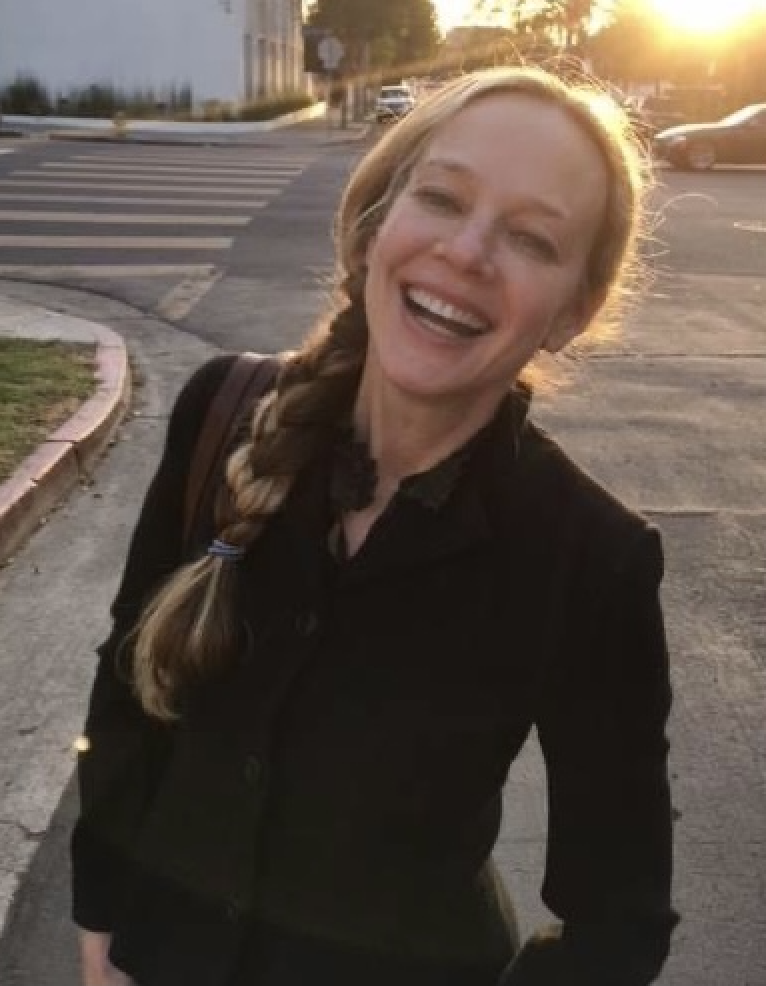
Henriette Lazaridis Power talks about The Clover House, being caught between cultures, why she loves Dickens, and so much more


I first met Henriette Lazaridis Power at a reading and got to know her when a bunch of us all headed out into Boston for food and wine, and I was lucky enough to sit next to her. Spectacularly talented, her amazing debut, The Clover House, is about identity, longing and the cultural bonds we choose to keep. I'm thrilled to have her here. thank you, Henriette! 


Calliope is a woman caught between cultures. How much of that informs your own life as a Greek-American woman with family in Greece?
I share Calliope’s preoccupations with cultural identity, and have spent more brain time than is probably healthy trying to figure out what label best suits me. Especially because my ethnic background isn’t obvious (I don’t look particularly Greek, and unless I include my maiden name, all you see is a French first name and an Irish last name), I feel as though I might lose my Greekness if I don’t make a point of claiming it publicly. What I have only recently realized is that my way of thinking and various aspects of my behavior are very much shaped by my Greekness, no matter what language I’m speaking or what country I’m in.
In many ways, writing Callie was a way for me to try on for size certain choices I haven’t made to resolve the dilemma of cultural identity. For instance, Callie completely cuts herself off from her Greek heritage at one point, in a misguided attempt to simplify her life. I have often fantasized about doing just that: it seems such a clean and straightforward approach, creating a sort of aerodynamic self that moves swiftly and smoothly through life. But it’s not possible. The ties are there and they keep pulling me back. And the truth is that I am happy to be pulled.


It took you eight years to write this novel. What was that process like? Was there anything you'd do differently in writing your next novel? 
It actually took me both much less and much more time than eight years to write this novel. Let me explain that. When I first contemplated quitting teaching to take up my pre-academia dream of being a writer, I went to the stories I knew best: stories of my parents’ childhood and youth during the Second World War in Greece. I wrote a mediocre novel that had something to do with that (and that will remain in its desk drawer), but when I finally did quit teaching, I began working on another project that had no connection to that earlier narrative. Whenever I took a break from that manuscript, I would tinker with some story or other from World War II, one of which was published in the New England Review. At one point, I set the other book aside, thinking it was done, and I returned to the World War II story. I came up with the character of Calliope Notaris Brown, a 35-year-old Greek-American woman who is wrestling with the legacy of her mother’s life during the war--a legacy she can feel in her mother’s coldness and sorrow, but that she can’t quite understand. Once I had that, I wrote a good draft of the novel in a matter of months. I wrote much of it during the winter, with the curtains to my study closed so that I couldn’t see the passage of time. It was exhilarating, and I treasure my memory of that experience. I hope I’ll be able to capture that feeling again.

At the moment, I’ve returned to that older manuscript once more for a final revision. But for the book after that, which I’ve begun notes for, I want to be better prepared. With The Clover House, I had at least a chronological structure to the narrative, provided by the timeline of Carnival celebrations in Patras, Greece. In the past, I’ve embarked on writing projects without much of a structural overview. I vow to do things differently next time. It’s easier to dig into the work, I think, and to get that sense of exhilaration when you have at least a framework to guide you. It’s sort of the way masons will set up their plumb lines and horizontal string guides so they can build their wall within them.

When Calllie flies to Greece to claim her inheritance, she's actually inheriting a lot more than physical goods. Can you talk about that please?
For better or for worse, Callie has inherited certain behaviors from her mother. Just as her mother pushes people away, so does Callie. Clio’s actions emerge from a deep sense of shame, while Callie’s have more to do with a fear of commitment and a belief in the frailty of human connection, but Callie has certainly learned that behavior of shutting people out from her mother. Callie has also been fed with the conviction that the world of her mother’s stories is perfect. She inherits from her mother this dream of an idyll--and the attendant inability to find happiness in the present.

Of course, it’s not all bad. Callie also inherits beautiful memories of her own--memories of family closeness and warmth and protection. She inherits a store of scents and tastes and sensations that, though abstract, is no less powerful than the accumulated objects in her uncle’s home. This is the legacy that sustains her and that actually has the power to help her quell her more destructive impulses.

So much of The Clover House is about the stories we choose to tell, or choose to keep secret. Can you talk about that--and about the power of stories?
We place such emphasis in our culture on communication and on “sharing”--a usage that makes my skin crawl. That word--sharing--implies that there’s some equivalence gained when one person tells something to another. In fact, most of the time, the information creates or sustains an imbalance. One person is usually in a more powerful position than the other, thanks to having conveyed that information. Communication certainly resolves conflicts and mends hurt feelings, and I would never dispute its value. But we forget that often it’s what we choose not to say that can do the most to repair or sustain a relationship and that can keep people on equal and cooperative footing.
In The Clover House, I wanted to explore how a secret can be both source of conflict and source of forgiveness at once. The central secret in the novel comes from shameful events and generates further shame. But forgiveness and closure don’t come from the revelation of that secret. They come from the partial withholding of that information. In deciding what to tell and what to keep--that’s where we all create stories, whether we’re writers or not.

As an engine of narrative, I don’t think there’s much better than a secret. Immediately, a secret creates a gap, and the energy of the novel requires that that gap be filled. The novelist’s challenge is to fill the gap at the right pace. I always say that the writer needs to dole out information like an intravenous drip. Too fast or too slow and you lose the reader to the unconsciousness of sleep or the hyperactivity of inattention.

What's your writing/daily life like? Do you have rituals?
I am a serial monogamist when it comes to writing rituals. I believe in them and am probably too much a creature of them. But I don’t keep them the same for very long. If I weren’t doing so much book-promotion activity right now, my writing routine would go something like this. Go for an early-morning row in my racing shell on the Charles River, shower at the boathouse so that I’m ready to go straight to my desk when I get home. Quickly read the New York Times (in print), and then work with a cup of coffee by my side and a baked good of some sort. Later, I eat when I get hungry and have been known to forget lunch. I keep a pad of A4-size paper beside my laptop and maintain a running conversation in its pages. Sometimes it’s a to-do list for the upcoming section; sometimes it’s a scolding I need to give myself; sometimes it’s notes as I work out a narrative problem.

What's obsessing you now and why?
Without question, I am obsessed with point of view. In returning to that older manuscript I was working on before The Clover House, I thought I wanted to redo it in omniscient point of view. But I’m finding this maddeningly difficult to conceive of, never mind to achieve. I am poring over novels that experiment with this and other kinds of voice--like Joanna Smith Rakoff’s wonderful A Fortunate Age, Chris Castellani’s All This Talk of Love, Anne Enright’s The Forgotten Waltz whose first-person narrative makes you want to live in the world of narrative voice, What Maisie Knew, that does such a crafty job of indirect discourse. I know I’m not alone in my conviction that the selection of the right narrative stance makes or breaks a novel.

What question didn't I ask that I should have? 
Who are your favorite authors?

Among the classics, Dickens without doubt or hesitation. The man was ahead of his time, a post-modernist before modernism. Still, you can keep Hard Times and A Tale of Two Cities. Give me the doorstop Dickens: Our Mutual Friend and Bleak House with its two (two!) narrative voices. And The Mystery of Edwin Drood, the most tragically uncompleted novel of all time.
Among the contemporary novelists, Ian McEwan, Michael Frayn, Anne Enright, Elizabeth Taylor (no, not that one), Kate Atkinson, and Tana French. These are all British writers, yes, and for some reason I have imprinted on the Brits, perhaps because I lived there for four years. Among Americans, there are many but one stands out: Tom Drury.

Monday, May 20, 2013

Beth Hoffman talks about Looking For Me, being a "card-carrying nut" about antique furniture, writing, and so much more


Want advice, cheer, support, championing and staunch friendship?  Beth Hoffman willingly dispenses all that and more, with ultimate grace and warmth, plus she's a stupendously talented writer. T
welve days after her first novel was published in January 2010, she became aNew York Times bestselling author with foreign rights selling to Italy, Germany, France, Poland, Norway, Hungary, Indonesia, Korea, Israel, and the United Kingdom. She's also an award-winning designer and a painter, whose work is in private and corporate collections in the United States, Canada and the United Kingdom. Her newest novel, Looking For Me, is about family secrets and finding your place in the world, and I am so thrilled and honored to have Beth here to talk about it. Thank you, thank you, thank you, Beth!


So much of this lovely novel is about restoration—of the antique furniture Teddi finds and of the past she must come to grips with. Do you ever think of the past as a messenger to the kind of future we should be living?

I believe the past holds many gifts for us in its hands. The experiences we have and the people we meet (be they positive or negative) have come into our lives for a reason. It’s up to us to figure out why and see what hidden treasures are waiting to be discovered. While positive experiences can be life changing, I find it’s frequently those that are painful that hold the most valuable lessons and offer the greatest opportunity for growth. So often we have to look back and sift through memories with eyes that have been opened by the passage of time before we can truly learn, heal, and move forward. In my case, as well as Teddi’s, this has certainly been true.

You hit the NYT bestseller list with Saving CeeCee Honeycutt. What changed for you after that? Did you feel differently or did you think you should feel differently and you didn't?

As odd as it might seem, besides being thrilled and a bit overwhelmed when I learned the news, I don’t feel that becoming a New York Times bestselling author has changed me. It’s rather like the old Zen saying: “Before Enlightenment: Chop wood, carry water; After Enlightenment: Chop wood, carry water.” Perhaps if I hadn’t nearly died of septicemia before leaving my interior design career I’d feel differently. But coming so close to death’s door is the thing that changed me. I was just so happy to have finally gathered the courage to switch careers and go after my lifelong dream of writing a novel that little else was on my radar.

Sense of place is so important to your characters—is it also crucial to you? Could you imagine living anywhere else, say, as my neighbor in NYC?  

Sense of place is extremely important. Loving what surrounds me is vital to my happiness and directly impacts my creativity. To thrive, I must feel a connection to a home that has a rich sense of history and possesses architectural character, and, I need to have gardens and trees and daily visits from wildlife. I’m a quiet person and a wee bit reclusive, and though I thoroughly enjoy people (in limited doses), I’m at my best physically, emotionally and spiritually when I’m at home. I need my furbabies close by while I write, and I need the solitude of working in the garden when I take a break from the written word. I have no doubt that you’d be a terrific (and fun) neighbor, Caroline! And while I do enjoy visiting NYC for business, I don’t think I could live there.

How much of Teddi's love for furniture is also yours? (I know you owned an interior design store!)

When it comes to finely crafted furniture and antiques, I’m a card-carrying nut. I get weak-kneed at the sight of burled walnut chests, and giant armoires with hand-carved details take my breath away. I have a real thing for certain chairs, and I once squealed out loud when I saw a rare, 1780s Prince of Wales chair offered at auction. Like old homes, antique furnishings and accessories have fascinating histories and a patina that can’t be replicated. There’s nothing quite like smoothing my fingertips over an eighteenth-century chest where the drawers have been dovetailed to perfection and the marquetry inlay is sheer artistic genius. I’ve always been awed by the pride and care that old world craftsmen strived for, and achieved.

What's obsessing you now and why?

I’m obsessed with trying to figure out how I can add a few more peonies in my garden. They’re my favorites and I can’t get enough of them, yet there simply isn’t an inch left.

What question didn't I ask that I should have?
You (blessedly) didn’t ask me what I’m planning to write about next, and I am so grateful! I’m the kind of writer who needs my ideas to marinate for a while. So for now, I’m quite happy to listen to the chatter of possible characters in my head, but I don’t feel compelled to write about them—at least not yet.

Beth Hoffman’s website: www.bethhoffman.net

Jessica Anya Blau talks about the Wonder Bread Summer, face creams, writing, and so much more.


Jessica Anya Blau isn't just the author of Drinking Closer to Home, The summer of Naked Swim Parties, and her extraordinary new novel, The Wonder Bread Summer. She's also one of the smartest, funniest, most generous writers on the planet. I'm so thrilled and jazzed to have her here. Thank you, Jessica! My blog is always your blog!


What sparked the writing of this book?

When I was in college I got a summer job at a tiny little dress shop on a shady intersection in Oakland with a liquor store across the street, a rib joint down the street, and a few boarded up old houses across the street. No one ever came in the shop and the owner paid me with cash from the register. I didn’t figure it out right away, but eventually I realized that the store was a front for cocaine dealing. And, when the owner locked the shop door and tried to talk me into taking off my clothes, I realized he didn’t even care if I made any sales. When I look back on that time in my life I see myself as someone who always wanted to please people and be friendly and good. And someone who didn’t know how to say no. I tried hard to never “disappoint” people and that, at times, led me into horrible, messed-up, murky situations that were hard to get out of. I took this idea of myself as vulnerable like that (at the dress shop) made it a little bit worse (or maybe a lot worse!) and wrote the novel from there.

The Wonder Bread Summer not only has a great title, but it has this wild and wooly humor to it that I just love. So does this fit in with your basic world view?

Well, yeah, I guess. I do think that pretty much everything is funny. It runs in my family. When my mother was in Intensive Care in the hospital and the doctors were telling us she wasn’t going to make it through the night, my brother, sister, father, and even mother (when she was conscious) had a whole lot of good laughs about . . . well about everything except the fact that she was in the hospital. Meanness, torture, poverty, and abuses of power are not funny at all. But a life survived can be pretty funny. People are odd. We’re all dorks. We’re all ridiculous. Just being alive is hilarious to me.

Did you research the 80s for this book and what was your research like? Anything surprise you?

No, no research. Other than going to Google and asking what the top TV shows were in 1983, or Googling the top 40 music, etc. The rest is pretty much from memory.

Can you talk about your writing life? Are you a creature of habit? do you have rituals? How DO you write? Do you plan things out like John Irving or do things unfold for you organically?

I usually have a nugget of an idea to start with and then I just write forward and figure it out as I go along. There is often some vague notion about where I’ll end but by the time I get to the end, everything has changed and I’m writing something totally different. What I do next is rewrite from the beginning and revise it as the story I ended up writing and not the one I had intended to write.

I drink a lot of tea while I write. And if there are snack foods around, Cheese Nips, or something horrible like that, I’ll eat them continuously!

What authors influence you and why?

Oh, everyone influences me, everything I read. I read everything but fantasy, and all of it feeds into me. I don’t try to deliberately copy anyone but sometimes when I’m writing, I feel a sort of déjà vu and I realize that what I’m doing is somehow related to having read so and so. I’m reading Justin Cronin’s book now and read Dave Eggers latest just before that. I read and loved Pictures of You!

What's obsessing you now and why?

HMmmm, right now I’m obsessed with finding time. I have three major projects that I’m in the middle of and I worry I won’t be able to finish any of them. And then I have all this stuff I want to start. I have kids, a dog, a husband, a house, great friends and I need time to be with all of them and take care of the ones I need to take care of. I hope I live to 169 or something so I can love all the people I love and write everything I want to write. Oh, I teach every semester, too, and that takes time.

I’m also obsessed with anti-ageing, sun-damage-repair face creams (see live to 169 above). I read about them online, read reviews and spend ridiculous amounts of money on them. Although I should point out the Olay Regenerist line is pretty darn great and not so expensive. And the L’Oreal BB cream is FAB!

What question didn't I ask that I should have?

You ask great questions! Oh, movies, you didn’t ask about movies. I love movies almost as much as I love books. And I love great TV, too. Mad Men, GIRLS . . . I adored that Julia Louis Dreyfus show VEEP and am looking forward to it coming back.

My new hero: Bob Harris, the author of The International Bank of Bob, who gave up wealth to fund impoverished people worldwide


There are some people who literally don't just change the way we see the world, or the way we act in that world, but they change the world itself. It's my honor to host Bob Harris, author of The International Bank of Bob--and yes, he is my new hero.  And wait until you hear his story. 

He was hired to write about luxury hotels for Forbes Traveler magazine (we are talking $3300 a night rooms) but something didn't sit well with him about all this excess. Instead, he used the money to fund micro-loans to desperately poor people all over the world, establishing what he called The International Bank of Bob and using the non-profit Kiva.org to help. 

You adore him now, right? 

He's been a TV writer, a Jeopardy game show champ, and even a comic, and in his book he tells how he traveled the world to visit the recipients of these loans. The book is amazing, funny, and important--and so, really is he. 

Bob, I'm so honored to know you. Below is something he wrote from TakePart.org.
Thank you, Bob. For everything you do, for being on this blog, for being the change instead of just talking about it.


Not long ago, I was in Kigali, Rwanda (an introductory phrase that I never dreamed I might write so casually), watching a small boy in an Annie T-shirt playing with a marble.

The child was surrounded by fruit, vegetables, sugar, cooking oil, gum, candy, and dozens of the same sundries you might find in any small convenience store.  This was his mother Yvonne’s place of business, the front half of the family’s two-room home.*

Yvonne is a client of a local Rwandan microlender whose loans are partly financed through Kiva.org, a charity website where people like you and me can invest as little as $25 in mom-and-pop businesses in more than 60 countries.  Through Kiva, I’d sent $25 chunks of my own cash toward hundreds of clients like Yvonne all over the world.  Now I was traveling five continents to hear the stories of as many clients as I could.  (The ensuing book, The International Bank of Bob, was just published by Bloomsbury.)

A year and a half earlier, Yvonne and her three kids didn’t have a giant stack of produce to sell and a home with a solid roof.  They were sleeping on a mat in an unpowered shack that Yvonne rented for the equivalent of five U.S. dollars per month.  Their prospects weren’t exactly promising, either: Yvonne was a single mom in a country still recovering from genocide and war, with no advanced skills beyond sheer persistence.

But persistent she was.  She learned from friends how to buy sweet potatoes, sorghum, and other staples in bulk, transport them home, and sell portions at a mark-up, providing the same profitable convenience as any Western 7-Eleven. Yvonne’s first loan to buy bulk goods was for 70,000 Rwandan francs—the equivalent of about $140.

Prior to the arrival of microfinance, Rwandan banks required five times as much just to open an account.  Yvonne’s loan would have been inconceivable, and her kids would probably still be sleeping in the unpowered shack, instead of curling up in a real bed under a good roof.

With stability in the family’s life, the kids can attend school.  The boy in the Annie shirt will soon learn to read the word Annie.  Since literacy breeds opportunity, these children may well have a wholly better life simply because their mom had access to these tiny loans.

When I was a luxury travel writer, I used to stay in some of the world’s fanciest hotels.  I barely recall most of them.  But I’ll remember Yvonne’s home, her kids, and her story, plus the stories of the other clients I met all over the world—from Peru to Bosnia to Kenya to Lebanon to Nepal to Cambodia and beyond—for as long as I live.

It is pure joy to be able to share it all. 

Sunday, May 19, 2013

Gail Godwin, author of the extraordinary Flora, talks about TOURING!


Gail Godwin is a genius, and also one of the warmest, loveliest women on the planet. I was so lucky to be invited to a lunch with her and I, of course, wanted her to be on my blog. She is the author of 13 novels, 2 story collections and non-fiction works. Three of her novels, The Odd Woman, Violet Clay, and A Mother and Tow Daughters, were National Book Award finalists, and five of them (A Mother and Twp Daughters, The Finishing School, A Southern Family, Father Melancholy's Daughter, and Evensong) were New York Times bestsellers. She's the recipient of two National Endowment Grants, one for fiction and one for libretto writing. Flora, her new novel, about remorse, loss, and a child and her caretaker, is a stunner. I'm thrilled to have this piece from Gail, on the business of touring.


Caroline: since you and I are both on tour, which is a surreal mode of living, so alien to what we writers do when alone, I'll tell you what is foremost in my mind this morning.

In  room 417 at the Washington Hotel, after a good room service breakfast. Yesterday I actually did something I considered worthwhile: a forty-minute talk with Bob Edwards on Sirius Radio. We laughed, I read passages from Flora that he had chosen, unexpected choices that were so right that I have decided to use them in my reading tonight at Politics and Prose.

I am very tired, but going on adrenalin and the desire to be a Trooper.  You have your wonderful Old Gringo red boots as your magic costume, I have my 24 year old silver Armani jacket and scarf.  So we swagger, or sashay, on stage. After the reading at Politics and Prose, Jim and Kate Lehrer are giving me a party at their house.

  But what is keen in my mind this morning is this: How can I use this time--so alien to the kind of time that we need to produce our novels--to serve me when I get back home? And as I was eating my lovely breakfast, it occurred to me that I needed to invent a kind of emergency writing code which would allow me to trap the talk, sights, essences, of these hectic tour days--an emergency shorthand that can encode the essences in that little notebook you saw.

The other thing--call it my magnificent obsession--is this. We writers are a freemasonry and we need to connect and uphold one another in every imaginative way we can think of! And you, Caroline, with your Leavittville blog, were among the first of us to perceive the possibilities.

So: that is this morning, on tour for my fourteenth novel, eighteenth book, in Washington, D.C., looking out my window at the Treasury Building just a month away from my 76th birthday.

Keep those red boots moving, Caroline, and I'll slither nobly through the rest of my tour in my silver threads.

Gail Godwin

Saturday, May 18, 2013

Come tweet with me on Tuesday from 8-9 at Literary New England Tweet Chat!


Come on, isn't there something wildly personal that you want to ask me? Now is your chance? The wonderful show Literary New England is hosting a tweet chat for me, this Tuesday from 8 to 9 and you are invited. The Wonderful Cindy Wolfe Boynton will be asking me questions and you can, too.  To join just use the #LNEChat hashtag.

I'm so excited to do this, and I hope to see all of you!

Warmly,
Caroline

Thursday, May 16, 2013

The amazing, funny, supersmart and super cool Rew Starr talks about her wild, innovative show Rew & Who?, being a songstress and a mom, skeletons in closets, and so much more


My friend, the writer and performer Polly Frost (that's her on the right!) invited me on this show filmed in the East Village called ReW & WhO? How could I resist?  Held in the back of a bar, it was both stunningly surprising, tons of fun, and Rew even had cookies. The shows are amazing and so, according to the New York Times and me,  is Rew. I'm thrilled to have her on. Thanks, Rew!

I've never been on a radio show like yours. 

I think we are the only one like it!:)


 How'd you come up with the idea for the radio show? Were the early days different than now?

Actually I had NO idea in the world i would be doing this. I was in a band called 'ReWBee'. with another person amed  'Bee." Bee actually asked me to be a cohost to a web show (everyone calls us a radio show but we are on the internet  and more like TV) with him. I said sure & *ReWBee's World* began. {2/18/09} after six months shooting in a storefront studio on the upper upper west side (Arizzma entertainment.) Bee decided he was ready to split, so overnight (literally) the show turned into *ReW & WhO?* (8/12/09) and that is when I decided each episode would have a different cohost ( the 'WhO'.)  I felt obligated to all the guests that were on the calendar and wanted to be able to still have them come on the show so I kept it going.  The show has morphed and transformed  and after another phase I decided to move the show downtown to 'Otto's Shrunken Head' on Joey Ramone's Birthday (5/19/10) and that is when I took full producer role as well.  I had no idea what i was in for but the show keeps going and going and now there is a one/friday/month Brooklyn edition as well at 'the Branded Saloon' which just celebrated two years! The show has taken over my life with booking, hosting and everthing else you can imagine.  Our motto comes from Marilyn Monroe's quote "Everybody is a star and deserves their right to shine".   I so agree with that, and I also want to give Warhol's promised 15 minutes to all the people with PaSSioN on this planet! My dream is to eventually go to every city and highlight  rising stars and living legends worldwide, bringing them to the globe via our web show! I have done 3 out of London and in other cities around the country and I swear I am inspired constantly by the cool people I get to meet with each show.

I especially loved the "What's the Skeleton in your closet" segment, which came with free cookies!  What's the most startling thing someone ever told you?

Ha, glad you liked that! It's funny cause I have learned that every day has a unique food holiday, so each show celebrates the 'food of the day' you got to come on National Chocolate Chip day!! I swear i don't make them up! We have had a giant array of 'skeleton' treats over the years! (guacamole day, kahluah & strawberry day, garlic day and on & on...} The segment comes from a song I have called 'skeletonz'  and yes, my life is somewhat a 'skeleton in the closet' and I think we all have ours. We have heard some crazy stories: car chases, arrests, lots of drinking and drugging.. sleeping with... it goes on.. I have to say yours was definitely in the top best 'skeletonz'. 

I realized you were getting me to open up in ways I didn't in other shows--how do you do that?

You know it's funny so many people tell me that! I always think I am just chatting away, and then somehow people seem to open up like you did.  I just want the guests to have fun, feel relaxed and comfortable.  I am just being my blabby self and people seem to tell us great stuff about themselves.  I really enjoy people and chatting and seeing them talk and have a good time reliving their experiences.  Sometimes I have people say they said a bit too much and they ask to edit, especially when they think it may bring the law in somehow!  I am simply being myself. I am always on the job training and I am the queen of winging the best I can it in all situations.

What cool things should people know about you and why?

Hmmm... well I am a songstress and a Mom.  I have been dabbling in some acting this past year and I have landed some songs in some films and television. My grandmother was in Vaudeville, my Mom was on Broadway and I feel I am just following my inner path.  It took a long time to get here HA! I was always in such a hurry.. college at 16... dabbling in lots of danger... but somehow I always believed in some happy ending.  I always say I am an optimist or I live in total delusion.  My songs are from the heart always. I call myself 'PuNkTrY" cause i have a punk rock heart and tell way too much information in the words!  Everyone's favorite is "u suck' the dirty ditty that won 'Best punk song of 2011' on Pirate Radio of the treasure coast and was on 'the Bad Girl's Club' show.  Somehow, I still feel that song hasn't peaked yet and has a lot of living to do!

How can people support the show?

Th show survives on donations for now. YOU can always send a generous donation through our website .. www.rewandwho.com I still am praying for my *fairy god sponsor* to be able to actually pay my wonderful staff who show up every week, and get us around the world, all the FOOD of the day treats & THE technical expertise equipment so we can really FLY!!! {and pay the rent!!}

What's obsessing you now and why?

This show obsesses me all day every day. I am constantly finding guests, working on every week all day long.. My family can attest to that! They think I am glued to the computer always, like even right now typing all this!
 I am always obsessed with that pain in the ass body image BS.  I hate that whole thing but like i said my songs usually tell all. 

What question didn't I ask that I should have?

Grammy or Emmy?

Oh, Rew, you deserve both.

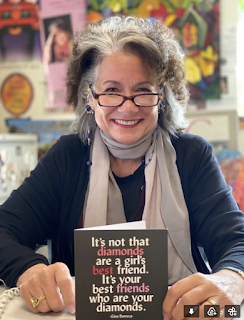
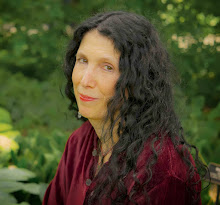
Madalyn Aslan talks about astrology, fame and so much more


Anyone who knows me knows that I have tarot cards and I go to psychics and astrologers. I met Madalyn Aslan online and we quickly became friends. I was thrilled when she gave me a reading--which turned out to be so accurate, that it was a little unnerving.  I'm thrilled to have her here. Thank you, Madalyn!


1. What started your interest in astrology? When and how did you discover you were intuitive?

I think everyone is born intuitive. Babies in the pre-verbal stage pick up their mother / father / caretaker’s emotions and intentions intuitively. As do animals, constantly. I only developed it more because I had to, as a kind of survival skill. No one chooses to be a psychic - I certainly didn’t. I grew up in a very bizarre environment, and developed my psychic skills as a way to navigate through that. 

As for astrology, it was purely a matter of fascination for me. It was a metaphor I liked, and I loved history – the Greek and Roman mythology (I studied Latin and ancient Greek growing up in London) – and, like any writer, I think in terms of pictures and imagery. Astrology was my first introduction to that world, after C.S. Lewis and Nancy Drew. I LOVED Nancy Drew. I always wanted to be a girl detective!

Being a kid astrologer was the closest – and most interesting – form of being a girl detective I could find. I was curious about everyone and about what made them tick. 

Later, when I was reading people for a living – I put myself through Cornell this way (I was an emancipated minor at the age of 16, coming from London) – I realized that it was much more than “sussing” people out, as they wanted to know about their future and what was the best thing for them to do. And that’s when - I believe - I really started to do the work properly.  

My first filmed reading was for Rock Hudson in Malta when I was 14, and that changed a few things. 

Nevertheless, I wanted to be a writer, and I pursued that through graduate school, and even through a PhD – leaving NYC after some success there – to go and live in an obscure part of the country for ten years. Many times I have tried to give up being a psychic, and it has never worked out. The psychic never knows for herself…irony of all ironies!

 2. You also study palms and you mentioned that the palm changes every three
weeks, which I found fascinating. Can you talk about this please?

Each psychic has their own discipline – astrology, tarot, hands – and this is mine. I LOVE the hands, and this is where I get all my psychic info (names and dates and such). You can tell an extraordinary amount from the hands – everyone can – I have taught palmistry to children in grade school (they are naturals) and at NYU in my English classes, and at Knightsbridge’s College of Psychic Studies (in London). 

The lines on your hands do change every three weeks…I’m constantly looking at my own hands to see what’s going on. It’s the result of the shifting circumstances in our own lives – I see this daily with NYC clients when they email me hand photos from their phones. Why this is most exciting is because we have access to free will and choice. It really is possible to change our fate and destiny, at any time. 

Carl Jung said, “Until you make the unconscious conscious, it will direct your life and you will call it fate.” This is my favorite part of the job. I have a slight advantage over a therapist in that I can see the future. 

3. What struck me, in looking at your book, was how creatively someone can use astrology to their benefit. Can you comment on this?

Absolutely. My favorite part of our “creative interaction” with our fate or destiny (or astrology) is the ability to utilize our Jupiter sign – our fortune, our profit, our good luck. Our Jupiter sign is often completely different from our Sun sign – the sign you have always believed yourself to be. It gets quite detailed – you have to read my book (Madalyn Aslan’s Jupiter Signs) for more! 

4. Were you startled to find yourself famous?

Yes. I actually spent a great deal of my life trying to get away from that, having spent a part of my  childhood in Hollywood. To this day I have never hired a publicist, nor advertised, or anything like that. Even when the expose came out in The New York Times no one could find me because I had no website, no online activity, no published phone number, no agent, etc. 

I remember the morning after it came out, going to work (to read palms) at Felissimo on East 56th St. and there was a line of people around the block – all the way up Fifth Avenue past Harry Winston’s – waiting for me to read them. I was shocked. I particularly remember a couple who brought their newborn baby from the Upper West Side…somehow that was very emotionally moving. 
  
5. You also do healings--how does that work, and why does it work?

I think that’s what it’s all about (Alfie!) Without healing, and a positive outlook, and hope, why on earth would we carry on? Isaac Mizrahi famously – perhaps disparagingly – referred to me as “the Pollyanna psychic”, but what else could I be? I became a psychic to help. Information alone is not enough – I don’t care how right on that information is, alone it’s pretty cold. Unhelpful. 

6. What's obsessing you now?

How to heal our country of the violence-seeking, anti-education, anti-science, right-wing extremism popping up. It truly makes me despair. It really is a serious concern. Particularly if you have lived outside NYC or any of the major American cities, Deep South, as I did for some time. 

7. What question didn't I ask that I should have?

How did my reading for YOU go? What was it like? 

xo

Wednesday, May 15, 2013

Douglas Trevor talks about Girls I know, surprises, Boston, Denver, more


Hey, I blurbed Douglas Trevor's astonishing new book Girls I know, and called it "Deeply moving and ebulliently funny" and it is. He's also the author of a short story collection, The Thin Tear in the Fabric of Space, which won the 2005 Iowa Short Fiction Award and was a finalist for the 2006 Hemingway Foundation/PEN Award for First Fiction. He lives in one of my favorite cities on earth, Ann Arbor, where he is an Associate Professor of Renaissance Literature and Creative Writing. I couldn't wait to have Douglas on the blog so I could ask him more about the book and I'm so honored to have him here. Thank you, thank you so much!

Can you talk about what sparked the idea for this book? Do you prefer one form or the other?
            Girls I know began with a few sparks, but also with a lot of deliberateness on my part. For instance, I was determined early on to come up with a story idea for a novel that was eventful. Most of the short stories that make up my collection, The Thin Tear in the Fabric of Space, are about people in the throes of grief, but the losses that shape their grief all occur before the stories themselves. I was a little self-conscious, I guess, about being typecast as the kind of writer who thinks a lot about sentences and characters but less about plot, so I invested quite a bit of time thinking about plot, and reading novels for their plots, which I hadn't really done before.
            The idea of writing about a restaurant shooting specifically came to me in the midst of all this. I was sitting in a crowded diner in New York City where I was supposed to meet with an editor and there was an argument at the front between the cashier and a customer. I remember thinking, My God, what if this guy pulled out a gun and started shooting people? And then, almost immediately, I started to think about a novel based on the aftermath of such an event, and I knew right away that I was going to stick with the premise, both because I had never tried to write anything like that before, and also because a restaurant or café seemed like a great vehicle by which to enter a city.
            Even before I knew exactly what this novel was going to be about, I was determined to write about Boston. I had been a student there through much of the nineties, and my final year there I had spent a lot of time walking around in its different neighborhoods. I spent one afternoon, for example, out in Mattapan (where the character Flora lives with her sisters and grandmother), simply because I rode the Red Line until it ended. And I discovered Watertown (where Mercedes's grandmother lives) by virtue of taking a bus one day from Copley Plaza that happened to be going there. Of course, I had no way of knowing that these enclaves would be the focus of so much attention right before Girls I Know came out, due to the horrific bombings that occurred during the Boston Marathon. Growing up in Denver, which is a city whose neighborhoods drift into one another, I was always struck by the distinctness of Boston neighborhoods, so I wanted to explore that in my fiction. I wanted very much to write about characters from different ethnic and racial backgrounds as well: both to challenge myself as a writer and also because writing about America today means, inescapably it seems to me, writing about diversity.

Girls I Know grew out of a short story, but were there surprises in making it into a novel?
            Oh, there were endless surprises. I think the surprises are what makes writing fun. I had formulated the characters Walt Steadman and Ginger Newton very early in the process of thinking about the novel. The story "Girls I Know" was a trial run to see how they would work. So from the beginning I imagined the story as a stand-alone chapter in the book.
            I was really encouraged to dive into the novel based on the tremendous feedback I was fortunate to receive on the story. It came out in the journal Epoch and was subsequently anthologized by Laura Furman in The O. Henry Prize Stories and Dave Eggers in The Best American Nonrequired Reading. I had never had a short story of mine so widely distributed before, and I had never received emails from so many different readers of my work. A young man from Iran emailed, for example, and dozens of young, American women who claimed affinities with Ginger. But when I tried to write the opening chapter of the book, I immediately found that the first-person voice I had used in the story wasn't working. The book really had to be in the third-person if I wanted to inhabit all the different neighborhoods and perspectives in which I was interested. But third-person also required me to rethink the characters, or how they would feel from this slightly over-the-shoulder perspective, and this took time.
            Another huge surprise: wanting to write about Boston to the degree that I did created some problems with regards to plot. In the earliest version of the book, Ginger and Walt circle in and around the city to an enormous degree, and this created a "wandering" narrative.
            But the biggest surprise had to do with the character Mercedes. Early on I knew that the owners of the restaurant where the shootings occur, John and Natalie Bittles, would logically have a child, since they were invested in building a life and a community in Jamaica Plain. So in the first draft of the book I mentioned their young daughter, Mercedes. Then I more or less forgot all about her. I drafted the book up through the shooting, at which point the story was supposed to pivot and become more about Ginger and Walt. But something was troubling me about this arrangement and I realized it was Mercedes. Following her parents' deaths, she had been left behind in the story. When I went back to retrieve her, the book really took its current shape.

What's your daily writing life like? Do you outline or do you just "follow your pen"?
            I do detailed outlines that I usually depart from very quickly, but I find the outlines useful nonetheless. As a writer, regardless of whether the form in which I'm working is long or short, I need to have some sense of where I'm starting and where I'm ending. So, for example, I can't work on a story or a longer piece without having a title in hand, and some sense of a final scene or a concluding moment. But then, and this is just crucial for me, the characters weigh in. They refuse to do the things I want them to do. They do something else. They introduce another character, and so on. For me, that's writing fiction. If I've predetermined the path of the story then I've also, I fear, undercut the realness of the characters about which I'm writing. So the process can be quite messy, but even as the narrative slips out of my hands, I try to anticipate or have some idea of where we are headed. Which is just to say, I rewrite my outlines a lot.
            And I rewrite my sentences a lot too. I prefer to work with something, anything, other than a blank computer screen, so I try to get stuff on the page as quickly as I can. And then I move things around and rewrite and rewrite—often by pen. The best work days for me are the ones in which I write early in the day and then return to what I've written—to fiddle—hours later. But I'm the kind of writer who tries a lot of different approaches to a given scene or story, which can feel laborious at times. I'm hesitant to dismiss something without first trying it out because I'm always curious what I might pick up along the way.

Boston (my hometown) is a character itself in your novel. At one point, a character says, "You can't leave your hometown behind." Do you personally think that's true? Why or why not?
            I think it's certainly true for John Bittles, who says the line you quote above. And I think it's true for Walt, even though he denies it. I think it's true for me too. But I don't think it's the same for everyone. Ginger, for example, claims her background as a New Yorker repeatedly in the story, but I don't think a place of origin matters to her, really. She's all about where she's going. For me, origins matter for sentimental reasons. My relation to my own hometown changed after my sister died unexpectedly fifteen years ago. I'm not able to build new memories with her now, so revisiting Denver really matters to me because I'm reminded of when we were kids and I can see the parks and the streets we played in and walked alongside. And there is an intuitive understanding about where you grew up that I think is really valuable as a writer: a sense of detail and familiarity and intimacy. How you feel about where you grew up can't be corrected by someone else, or altered even if the buildings you knew as a child are gone. But, in a way, I feel that you have to lose or leave your hometown in order to understand its contours. Which leads me to your next question…

What's obsessing you now and why?
I'm working now on a novel set in Denver—about a guy in his twenties who learns that everything he thought was true about his family growing up was in fact a fabrication. This debunking of his past is juxtaposed with the novel's re-telling of the history of Colorado and the West, which has so often been fashioned so as to emphasize rugged individualism, which is only part of the story. I'm imagining the book as largely constituted by interlinked but nonetheless freestanding stories, the first of which—chapter three—is coming out in New Letters this fall.

What question didn't I ask that I should have asked?
            I thought you might have asked me more about the structure of Girls I Know. Sometimes as writers we do things that seem, to the reader, to be very deliberately done but weren't necessarily. In Girls I Know, for example, the three central characters are all "coming of age" in different ways: Mercedes is at the cusp of her teenage years, Ginger is twenty, Walt is about to turn thirty. So how self-conscious was I of this design of the book?
            I really wasn't very conscious of it at all. I remember thinking very overtly that Walt would need to feel justifiably—even if in a "young" sort of way—that he was getting older and needed to start to make some sense of his life. But Ginger and Mercedes, and even Flora, who waitresses at the Early Bird Café and is nineteen, are all about to embark on distinctly new phases of their lives. The same is true for Mrs. Bittles, Mercedes's grandmother, who is left to take care of Mercedes after her parents are killed. I think yet another thing that novels can teach us is how we are always growing, always becoming, regardless of age. There really is no such thing as stasis.
            Thank you, Caroline, for the chance to talk with you about my work!!